About Royal Canadian Legion JBC VC Branch 003
Royal Canadian Legion John Bernard Croak VC Branch 003 has a long and proud history of serving Veterans, their families, our members and the community of Glace Bay.
Our Branch traces its roots back to the First World War and the organizations formed to support returning servicemen. Over the decades, Branch 003 has continued that tradition by supporting Veterans, remembering those who served, and contributing to the community.
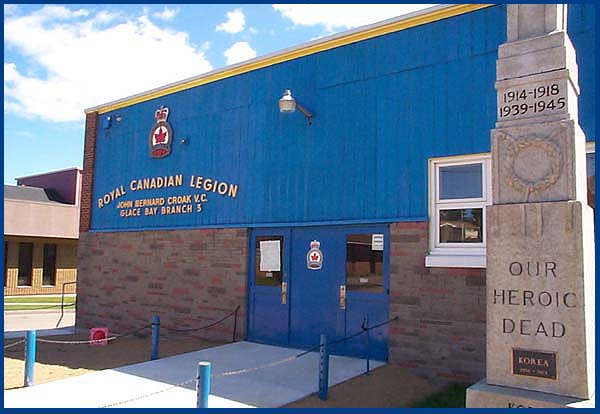
Our History
The beginning of Glace Bay Branch starts with the Kitchener Club. This organization was established in 1916 as a reception club for servicemen who were returning early as a result of casualties in France following the battles around the Ypres salient in 1915.
In the latter part of 1917, the Great War Veterans’ Association, known as the G.W.V.A., was formed. Representatives from Glace Bay took a leading part in organizing the association and, during the following year, helped develop plans for legislation concerning pensions and other matters important to the rehabilitation of ex-servicemen.
The G.W.V.A. continued its work during the following years, and the Glace Bay Branch played an important role in organizing other branches in the surrounding area.
Formation of the Canadian Legion
In 1925, a proposal was made to organize the Canadian Legion of the British Empire Service League, an organization intended to embrace veterans across Canada.
A unity meeting was held in Halifax, Nova Scotia, on May 18, 1926, to establish the Canadian Legion in Nova Scotia as the successor to the G.W.V.A. Glace Bay was represented at this important meeting.
On July 22, 1926, Glace Bay voted to change over to the Canadian Legion. The meeting opened as a G.W.V.A. meeting and closed as the first meeting of the Glace Bay Branch of the Canadian Legion. The officers of the G.W.V.A. were elected as the first officers of the new branch.
Branch 003 in the 1930s
During the early 1930s, the Branch became involved in an important campaign for a central sanatorium in Cape Breton to provide treatment for tuberculosis.
The Branch, with the help and cooperation of the local medical community, worked to determine the number of active cases and possible contacts in the district. The results of this survey helped demonstrate the need for a central institution.
There was considerable opposition to the proposal, but other Legion branches supported the campaign. A compromise eventually resulted in the government’s annex system being accepted. The original proposal was ultimately proven sound, as a central institution later operated at Point Edward, Cape Breton.
Branch 003 During World War II
During the Second World War, the Branch was proud to assist the men and women serving their country and to provide support to their dependents.
Members of the Branch contributed to recruiting and other aspects of the war effort. Recruiting committees, rehabilitation committees, the Air Observer Corps and other wartime committees included members of Glace Bay Branch.
The Branch Home
From the beginning of the G.W.V.A., the need for suitable accommodation was recognized. In 1922, the property on Union Street was selected and purchased. Although it was an expensive undertaking, the decision proved to be a wise one, and the building served the organization for many years as a true home for its members.
As the Second World War progressed, it became clear that a larger building would eventually be needed. In 1941, plans were developed either to add to the existing building or construct a new one. The present Branch hall is the result of that early planning and the years of saving that followed.
A Proud Tradition of Service
Glace Bay Branch was established on solid foundations, as demonstrated by its many years of uninterrupted service. The Branch has continued to plan for the future while maintaining its commitment to Veterans, their families, members and the community.
Throughout its history, Glace Bay Branch has been represented at Provincial Conventions and at Dominion Conventions, with the exception of 1950.
John Bernard Croak VC
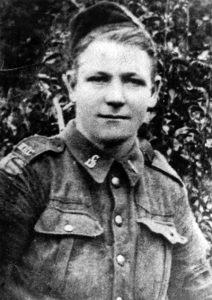
John Bernard Croak VC was a Canadian soldier of the First World War who was awarded the Victoria Cross for extraordinary bravery during the Battle of Amiens in August 1918. His courage and sacrifice are remembered through the name of Royal Canadian Legion JBC VC Branch 003, as well as a park and elementary school in Glace Bay.
Early Life
John Bernard Croak was born in Little Bay, Newfoundland, on May 18, 1892, to James and Cecelia Croak. When he was two years old, his family moved to Glace Bay, Nova Scotia.
He attended school in Glace Bay and, at the age of 14, began working as a coal miner.
First World War
In 1915, Croak enlisted in the Canadian Army and volunteered for overseas service with the Canadian Expeditionary Force. He initially served with the 55th Battalion and embarked for Europe in November 1915.
He later transferred to the 13th Battalion, which served on the Western Front as part of the 3rd Brigade, 1st Canadian Division. During 1917 and the early part of 1918, Croak took part in several major engagements, including the Battles of Vimy Ridge, Hill 70 and Passchendaele.
Battle of Amiens
On August 8, 1918, the opening day of the Battle of Amiens and the beginning of the Hundred Days Offensive, the 3rd Brigade was at the forefront of the Canadian advance.
The 13th Battalion became held up by German machine-gun positions near Hangard Wood. Croak attacked one of the machine-gun positions, bombed and silenced it, and captured the gun crew.
Although he had been wounded in the arm and had been instructed to seek medical treatment, Croak refused to stop. He returned to the fighting and attacked another strongly defended position.
During this attack he was again severely wounded. Despite his injuries, he continued forward and helped lead his platoon in a brilliant assault against the enemy position.
His Victoria Cross
For his extraordinary courage and determination, Private John Bernard Croak was awarded the Victoria Cross, the highest award for gallantry that could be awarded to a soldier of the British Empire.
Croak died of his wounds on August 8, 1918.
His Legacy
John Bernard Croak is buried at Hangard Wood British Cemetery, approximately 12 miles southwest of Albert, France.
His Victoria Cross was presented to his mother at Government House in Halifax on November 23, 1918, by Nova Scotia Lieutenant Governor MacCallum Grant.
Croak’s bravery and sacrifice have remained an important part of Glace Bay’s military heritage. Royal Canadian Legion John Bernard Croak VC Branch 003 proudly carries his name in remembrance of his service and sacrifice.